| fox@fury | |
|
Monday, Apr 22, 2002
Before Saturday morning arrived I had done a lot of research on the web. I wanted to know how things go wrong up there, how often, and what I could expect. Ironically, I wanted to make myself more comfortable by being fully informed of the realities, instead of relying on blind trust and assurances.
For example, one of the commonly used skydiving platitudes is that you have a greater chance of getting killed driving to or from the drop zone than skydiving once you're there. This actually isn't quite right. There are nearly 2 million jumps a year in the US, resulting in about 23 deaths a year, or one fatality for every 86,000 jumps. By comparison, there are 0.47 driving fatalities for every million driving hours, equating to one chance in a million of a driving fatality for a typical two-hour journey. Since the Byron drop zone was an hour away, that means the chances of a fatal accident on the trip there or back were roughly one-twelfth that of during the 7 minutes I'd be in freefall or under canopy. Another way of looking at it is that a single jump is about as dangerous as 24 hours of driving time (not continuous, of course). That way doesn't sound so bad. Driving to pick up Karen, who had graciously volunteered to come along to keep me company, provide support, and be my cameraman, I reminded myself that tandem instructors are among the most experienced, professional, and risk-avoiding bunch of the lot, and that though there are roughly 140,000 tandem jumps a year, a tandem crash only happens every 2 or 3 years, pushing the stats for my particular jump farther to the safer side. But enough with the statistics. I went out there Saturday to watch people skydive. I was willing to pay the $160 jump-fee to learn about the process, gather all the information I could, and back out in favor of a rain-check coupon before I got on the plane. I wanted to see people get in a plane. From the ground, I wanted to see them pull their chutes, navigate, and land. 'Normal, everyday skydiving' doesn't get much press. The average joe only experiences the media of skydiving when there's an accident, or when people are performing extreme maneuvers for the camera. Stories like "last Saturday, 18,230 jumps were made with no serious injuries, one broken leg, and 14 sprained ankles" never make it into the paper. It's just not news.
Jumping right into things, I was given a clipboard with two waivers, one absolving the skydiving company, and the other for the equipment manufacturer. These waivers were the most complete I'd ever read, not only saying I promise not to sue, but that they were not to blame even in the case of gross negligence, that I had provided financially for my dependents in the event of my death, that if I or my dependents should attempt to sue, they are simultaneously agreeing to a $25,000 fine for doing so, and that, in the event that I or they did sue and won, I or my beneficiaries would be entirely responsible for paying the settlement to ourselves, as well as the legal fees for all parties. They weren't kidding around.
Reading each clause and initialing them, I told myself it didn't really matter because I wasn't jumping out of a plane today anyhow. They checked that I initialled and signed everywhere I was supposed to, took my money, and put my name on the tandem list. It would be another couple hours before I was called up.
Watching landings is great. You get a real respect for the control these people have, and how far parachuting has come from the days of circular canopies and landings equivalent to jumps from ten-foot walls. Two things that Byron had in abundance on Saturday were sunshine and pollen. I'd been fighting an allergy attack for the past several days, and this new assault was easily too much for my own defenses. From the time I arrived my nose was runny, but walking out of the hangar and into the sunlight, staring up at the sky, sneeze followed sneeze, sometimes as many as 12 sneezes in a minute. There was no kleenex to be had, so I made frequent trips to the port-a-potty to get toilet paper for my nose (port-a-potty toilet paper is closer to sandpaper than a kleenex, an unfortunate reality that led to my nose still being sore and dry two days later).
We were told how to position our hands and arms out once we were in free fall, how to 'kick the instructors butt' upon exiting the plane, to get our legs in the proper position for a controlled dive position. We were shown the signals that the instructor might give, tapping our shoulder to remind us to keep our arms out, tapping our thigh to get us to kick back farther. Between the exit door and the canopy deployment there would be no words, because 125mph doesn't lend itself to conversation. All these instructions would be given to us again by our individual tandem instructors, we were told, but it was good to go through it once first, so we'd remember. Then there was more waiting. My allergies were really killing me now. an endlessly running nose has been joined by itchy, watery eyes that just wouldn't quit. I'd stand inside the hangar to watch landings now, because a little less sunlight helped to stop the sneezefest my sinuses had become.
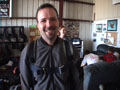
More sneezing, trips for tissues, and watching landings, and my name was called up, along with a few others. I went into the hangar, met up with my assigned instructor, who turned out to be Richard! Sniffling and blowing my nose, I suited up and Richard and I went through the procedure again. I'd paid for video and stills as well, so from this point I also had a camera guy (I never did catch his name!) who added a second reel of clips to the one Karen and I were compiling with my camera.
Strapped into the four-point harness that would hold me to Richard (and, by extension, the parachute) I was shown how to adjust the leg straps once we were under canopy, lifting my legs and pulling the straps down to make a seat instead of a groin swing.
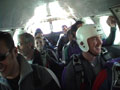
The rest, two tandem pairs and a handful of singles, pile into the plane, making a tight squeeze in two rows straddling long padded benches. They slide closed the plexiglass door, fire up the engines, taxi down the runway and take off. I've been in a lot of small planes before, so I wasn't too worried about this one, though I was idly amused that, after hearing so many quips about 'jumping out of a perfectly good airplane' I couldn't help but notice that the plane's pilot, along with everyone else, was wearing a parachute of her own. Perfectly good plane, my ass. I could see the large-faced wrist-altimeter of the jumper in front of me, and I watched as its needle rose above 3,000 feet, 4,000 feet, and higher. Richard attached the four harness points to his harness, and we spent a few minutes tightening the leg straps securely, working together to pull them to their tightest. Richard told me I ought to put my goggles on now. Then it was back to looking out the window or altimeter-watching. I was a little impatient to leave the crowded plane and get this show on the road. I was ready. Soon we were at 14,000 feet and were in position. The first jumper slid up the plexiglass screen and quickly, without fanfare or pause, was out the door. Richard joked that 'oh my god he fell out!' but I was already calm, and a little detached. I had a thing to do and it was just about time to do it. Looking back on it, I suppose the right word for my state of mind was 'detached' (not that I'd want to use that word anywhere near a drop zone..).
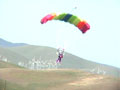
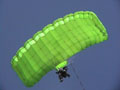
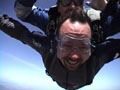
Falling, I kicked back and put my arms out. My mouth and nose inflated under 125mph of force. We were falling, it was a blast. It didn't feel like falling, or flying, and certainly not floating. When you're that far off the ground, you don't see it getting bigger unless you watch carefully. Instead, it seems like you're in this stationary place, with wind just blowing really, really hard. Breathing is weird up there. Taking a breath is like taking a drink from a firehose. Instead of sucking air in to take a breath, it's like not pushing air out quite as hard, letting it push its way in. I macked for the camera a bit, giving thumbs up, and when the camera-guy mocked picking his nose at me I was suddenly worried that I had a stream of snot or something just as glamorous going on, so I mock-picked back at him, not realizing 'till later just how silly this would look, seeing only my side of it, on the eventual tape. Too soon it was canopy time, and I was almost worried that there wasn't a sudden jerk. There was a pull which brought us into a vertical orientation, from the horizontal, and a pul that kept on pulling, more than a single gravity, but not the force that seemed necessary to bring us from 125mph down to 10mph vertical descent. Ow, that harness is pretty tight around the areas I'd really rather not have so tight. I waited for Richard to tell me it was okay to adjust my straps. After a few seconds he gave the okay and I brought my leg up to my chest to reach under and try to bring the strap forward. My hands and fingers were numb. I hadn't realized just how cold it was up there, but when I couldn't feel my fingertips I clued in. Still, I needed to move the straps and I could tell when my hands were in the right place so I gave my fingers and hands their marching orders, and though I couldn't feel my hands they did their work. First one leg, then the other. Ahh. Richard let me take the toggles (handles) while he held them higher up, so we could try a few gentle turns, and a couple tighter ones. It wasn't the roller-coaster ride I'd have expected, because while a roller coaster gives most of its thrill from pushing your body where Newton's laws wouldn't have it go, when you're under canopy making a tight turn, down always feels like the opposite of the canopy, even when it's 45 degrees off of vertical. Lots of fun. We practiced landing, with me lifting the toggles as high as I could, then bringing them all the way down to my legs, creating a momentary stall that, at ground level, would bring our vertical velocity to nearly nothing. "Don't try to stay standing" was one of the thing they pushed in the ground school. Especially guys. We feel the need to be macho, and forget that, in addition to falling out of the sky, our harness means that we'll be carrying both our weight and our instructor's weight, as the instructor is about 8 inches higher up in the harness. "Lift your legs forward" is the instruction we were given, and that's what I did. As we got closer to the ground, we leveled off, pulled the toggles down as far as possible, and slid easily into home. Seconds later I was unhooked and on my own two feet. Karen and I stuck around for a couple hours as they dubbed the tape and, at my request, made me a DV copy of the digital master for my own iMovie fun. That digital source, along with footage Karen and I shot with my camera, is where all this video came from. ... So you might be wondering: "What happened? You were going to bail out, you were worried, and then, what? You're in the air and out the door?" Well, It might seem like a cop-out answer, but simply, yes. I think it was the allergies. I was so distracted with the nose that wouldn't quit. I had so much to occupy my mind that the paranoia and fear of the door, falling, all of it, never came into play. I'll get shakes sometimes, before and after bungie jumping being a good example. I could put my hand out and see the shaking. Public speaking can do that to me too. Heck, even when I call in on a radio show and I'm on the air, I'm a little shaky. But here, in the plane, in the air, back on the ground, nothing. I didn't have that searing squinch of a squeezed adrenal gland, pumping fear and energy into my body. I enjoyed every second of the experience, and I'll probably do it again if the opportunity arises and the time is right, though I'm considering an AFF program (solo, and a full day of ground training). Karen said she'd consider jumping next time, as long as she doesn't have a trip planned shortly afterwards (she's going to Thailand, and doesn't want to hobble on a sprained ankle). Me, I'm just amazed at the power of a little pollen... Saturday, Apr 20, 2002
Seeya later!
Saturday, Apr 20, 2002
Friday, Apr 19, 2002
I'm happy to announce that Wednesday night witnessed the release of Yahoo! Messenger for OS X! This is the first software release since I started designing for Messenger back in mid-January. This version brings the Mac client closer to the Windows version, with support for typing notification, the extended set of smileys, idle-time notification, and of course, Mac OS X. Yay!
Friday, Apr 19, 2002
It was three weeks ago Wednesday, and like every Wednesday it was time for the UED group's weekly lunch-meeting. Since the speaker on this week's topic finished early, Ava, one of our newer gooeys (the pet name for folks in the GUI (aka UED) group) took the chance to field questions about her skydiving hobby.
I've thought about skydiving before, almost done it on several occasions but it was never the right time. I can't say the same thing for bungee jumping. My freshman year at Cal some of my hallmates were very into the idea, driving two hours to 'a train bridge where there are these guys' who will take $40 for two jumps. Forget about waivers and insurance; I'm not sure these guys had names. At any rate, I did end up bungee jumping three years later from a 250 foot crane above Boston Harbor under entirely different and unexpected circumstances, but that's another story. Last week Ava sent out an email letting the group know about a skydiving trip this Saturday. I signed up. I'd always been more afraid of skydiving than bungee jumping. At 250 feet, there's not much you can do but completely trust the equipment. There's no emergency bungee and, with a fall of only three seconds, there's not much chance to correct any error that might take place. From 14,000 feet and 60 seconds of freefall there's plenty of time to pull a MacGyver, or at least an emergency chute. As the time to dive approaches though, I'm finding a lot more anxiety than I had before, and I'm figuring out why. First off, I've never seen anyone skydive. I've seen Navy parachutists a couple times at sporting events, watched dives on TV and quicktime, and I've heard and read several firsthand accounts of friends' skydiving experiences, but I've never gone along, never seen someone I know jump out of the proverbial 'perfectly good airplane.' All my experience with airplanes are ones where the last thing in the world you'd want to do is jump out. I've been in a lot of planes: jets, seaplanes, four-seater Cessnas, planes with cabins smaller than a minivan with easy-to-reach door handles. I love to fly, and jumping out is one of those things that, though easy, you just don't do, like swerving into oncoming traffic on the highway. That's a lot to overcome. I dream about flying more often than anything else. For a long while I wanted to learn paragliding, and I read up on it, read the faqs, first-person accounts, and lurked on the SF Bay Paragliding mailing list for over a year. I'd read about people's triumphant days catching thermals over Mt. Tamalpais, flying along the coast at the Dumps, and wherever there was a good updraft. I read for a while because I wanted to get a fair idea of the danger involved. When a paraglider has a close call, they write it up, identifying what they did wrong (if anything), and how they (we) could avoid or recover from a similar circumstance. I read with fascination and amazement about the occasional technique workshops. One workshop, for example, involves gliding thousands of feet above a lake, pulling in your 'chute to go into freefall, and either re-deploying or deploying your emergency 'chute. If something doesn't deploy quite right, the drag, combined with the water-impact should offer protection. Safety is on everyone's mind, and every three or four months word would come of a paraglider who had a fatal accident. Locally, in Mexico, overseas, the accident seemed to have very little to do with the experience of the pilot or the conditions. Random. A frequent poster to the group died while I was a regular reader. He was a passenger on the Alaska Air MD-80 flight that went down off the California coast after its tail elevators malfunctioned. His wife, a flight attendant on the same flight, went down as well. The sorrow on the list (quite rightly) overshadowed the irony. Over time I decided that, while I'd enjoy taking the passenger seat on a tandem flight, I probably wouldn't want to get into the level of dedication needed to be a paraglider. Back to skydiving, it's one of those things I want to do once, to add an experience to the pile, part of living a large life. I'm glad I bungee jumped. I might do it again if the circumstances were right, but I don't feel the need to pursue it or proselytize to others. As with paragliding, for a while I followed the skydiving newsgroups to get a feel for the sport and the attached culture. I found that there are typically a few dozen skydiving deaths a year, out of several hundred thousand jumps and upwards of a hundred thousand participants, and that in recent years, a good percentage of those have been accidents involving the plane, and not the canopy (again with the irony). I was a newsgroup lurker when there was an accident at Skydance in Davis. A tandem dive (instructor and student strapped together, using a single canopy) went awry and both instructor and student perished. It was the only accident at SkyDance in the last 10 years, and toxicology reports indicated a high blood-alcohol level in the instructor. Skydiving isn't something I'm going in to blindly. The risk is minute, less than a hundred things I do every year, but with a much more comprehensible disaster scenario. Even with bungee jumping, my analytical mind told me that the #1 bad thing that could happen would be if the cord broke. This would be most likely to happen at the moment of maximum stress, which would be when I was at the bottom of the dive, with a zero velocity. Jumping over Boston Harbor, this would have meant a 15 foot drop into water. Not a bad compromise. As I mentioned, I only intend to jump once, which has also got its problems. If my goal is to enjoy the thrill of freefall, I'm not likely to be comfortable on my first dive. I don't see there being too much potential for mishap while jumping out of the plane itself, and so for the 60 seconds of freefall, I'd still be thinking about whether the canopy would open, only at that point there would be no turning back. Would this fatalism (poor word choice, but you get the gist) allow me to enjoy the experience in a que sera mentality? Or will I panic until the canopy opens? Anyhow, the train's pulling in to Santa Clara, so I'd better wrap up. The dive is tomorrow, and I'll bring my video camera. I still don't know if I'll jump, though I'll probably have to pay the $160 jump fee as the price for putting off that decision until after jump training. I want to see other people do it. I want to see the looks on their faces, and glimpse their pre- and post-jump mentality. I want to get comfortable with the idea that people do this all the time. I may or may not jump. :-) Thursday, Apr 18, 2002
MSN: Point: Global CD revenues fall another 5% in 2001 due to music piracy.
Blogaritaville: Counterpoint: Music labels have increased the average price of a CD by 16% in the last five years, despite a 60% drop in fabrication costs. The IPFA's analysis of international 2001 music sales places blame squarely on piracy, despite a lack of a geographic correlation between sales drops and internet access (the UK's music sales increased this year, and the US's music sales fell less than the international average, despite a nationwide recession). Also, they point out that sales of CD singles dropped by 16% while ignoring the fact that the number of CD-single titles published in 2001 dropped by a greater percentage, as record labels try to drive people to buying full albums. Unlike entertainment industries, consumers don't have a united voice, and as a result the media reports whatever the PACs and consortiums feed them. Thursday, Apr 18, 2002
I went to Fry's on Tuesday and made a couple purchases. This digital video kick, along with transferring all my CDs to mp3, is taking its toll on my G4's 36gig hard drive. Every four minutes of raw digital video takes a whopping gigabyte, so doing any significant video work gets hairy, and a couple days ago I experienced some strange errors which turned out to be because my disk was entirely full.
That won't be a problem again for a while now, though. I got me a 120 gigabyte drive for $245. That's enough for eight hours of raw digital video, 80 days of solid MP3s, or some combination thereof. It wasn't so long ago that a single gigabyte drive cost $800. Heck, back when I was a kid a 5 meg Tecmar drive was $699 and a meg of RAM set you back $140. Wednesday, Apr 17, 2002
"If all your friends jumped out of a plane, would you jump too?"
So I'm going skydiving. I can't guarantee that I'll actually jump out of the plane, but I'll be there, with still and video cameras in hand, to document the process and maybe see a few people jump out of planes. If I get caught up in it, then I'll join them. Like I told a friend yesterday, if I had a nickel for each time someone used the phrase 'perfectly good airplane' yesterday, well, I'd be able to buy a nice candy bar. Wednesday, Apr 17, 2002
I think I wrote about it before, but a cursory google search didn't turn anything up, and now there's another article...
I'm talking about Provigil, the FDA-approved pill that lets people stay awake for 40 hours straight, with no side effects (except mild nausea in a small percentage). As the LA Times reports, Provigil has been tested on swing-shift workers, military helecoptor pilots, and others extensively and is extraordinarily effective at obviating the need for sleep. It's not a stimulant, it doesn't give you a rush, or make you hyper, or have a corresponding 'low'. It just maintains a normal wakeful state without lethargy or decrease in attention span. There are days when I'm feeling creative, getting into the creative swing at 2am, and wow I wish I could just take one of these and be fine all night and the next day at work. Not every day, not every week, but once in a while it can make all the difference when time seems in such short supply. Tuesday, Apr 16, 2002
It's been a while since I've been on the train. Y'see, I started a Spanish class at De Anza College last week, and the class keeps me and my car in the South Bay two evenings a week.
« Newer Posts
Older Posts »
I take the train on Mondays, but Tuesdays I drive down so I'll have my car to take me to class after work, then I crash at Rick and Ammy's place in the South Bay, and it's a blessedly short commute to the 'Hoo Wednesday morning. Wednesday evening the lure of my own bed drives me home, then it's back in the car to drive back down Thursday morning, class Thursday night, and back home. On the weeks when I can't telecommute Friday I'll probably take advantage of Ammy and Rick's hospitality again Thursday night. All in all it means only one day on Amtrak a week, and I can tell you that I miss the time cut off from the net. In Douglas Coupland's book, Microserfs, the tiny group of hardcore programmers on a deadline would frequently code in their garage for 16 hours straight. They would refer to a stint like that 'flying to Australia' because that's roughly how long you'd have to sit on a plane to make the journey. "What'd you do this weekend?" "I flew to Australia twice. I could really use some downtime... and a couple Redbulls if ya got em." Sitting on the train, getting into the writing groove that's enabled me to start telling so many of the stories in me, quite often I'm on the train, approaching my stop, and wishing I could just stay on the train, venturing on to Davis, Sacramento, Truckee, wherever. So long as I could sit in this seat where the words flow freer than behind any desk, watching the world go by outside when I should need a few moments of inspiration. Listening to whatever comes up on the iPod's random shuffle and superimposing it over whatever is speeding past the window provides a wellspring of ideas. Unfocusing slightly and looking at the road paralleling the tracks while listening to REM's "Star Me Kitten" I can dip easily into childhood nostalgia to a depth impossible when surrounded by all the things that represent the now, be it a home, office, or car. Time exerts itself less heavily around train tracks; consequently there exists the constant allure of starting out the window into anywhen. Right now I'm about 10 minutes from my stop in Oakland, but I wish I could write all night. I've tried coding on the train, I've tried reading, and I've taken (this morning as a rare example) the occasional train nap. I never feel so at home as when I simply write, and there's no place else where writing feels so free. I know precisely why this is, but that's a story for another telling. The point is that, for the next couple months, there will be a little less storytelling, parabalizing, and ranting. The class ends in June and time will flow like the sands after that. In the meantime, expect daily updates, but perhaps of the shorter variety, save for monday spews like this one. Expect also an upswing in the work tempo of the pantheon of unfinished projects*. Underblog, Metacookie, Qwer and Randompixel will all get their turn as debutante before the Summer is out, not to mention Fury 4.0, which is already well underway... Well, this is my stop! I'd love to write more but (now) you know how it is... |
aboutme
Hi, I'm Kevin Fox. I also have a resume. electricimp
I'm co-founder in The Imp is a computer and wi-fi connection smaller and cheaper than a memory card. We're also hiring. followme
I post most frequently on Twitter as @kfury and on Google Plus. pastwork
I've led design at Mozilla Labs, designed Gmail 1.0, Google Reader 2.0, FriendFeed, and a few special projects at Facebook. ©2012 Kevin Fox |